|
How to
"do" Yosemite
Print this, get a map and follow along. Most people, be they foreign tourist or American, come to Yosemite as part of a larger tour of the USA. My wife used to tend bar at the Tenaya Lodge, and folks would spend maybe one or two days in the park and move on to San Francisco or the coast. When they got back from Yosemite, they would tell about going to the valley and spending some money in the gift shop and seeing a few easily accessible waterfalls and that's it! So, I'm going to tell you how to get the most out of a two day visit to the park. Getting here: Whether you fly in from Australia, or drive up from L.A., ultimately you will come into the park on four wheels. The best way is to rent a car if you're a flying tourist, or bring your own if you're "local". DON'T come on the bus. Yosemite is too big and there is too much variety to leave the schedule up to some bus schedule. There are four roads that bring people into
the park. As you now look at your map (GO GET A MAP!!!) you will see two western
routes (through Mariposa and Groveland), a southern route (through Fresno and Oakhurst),
and an eastern route (through Lee Vining). You might think that it would be
convenient to see the Grand Canyon, drive through Death Valley and come to Yosemite from
the east road. Not good. Especially in winter, because it's closed. During summer, Road 120, or the Tioga
Pass road, is a steep highway. There are NO services for 15 miles if you
break down. The road is VERY steep and auto overheating is a real possibility.
I would not want to be a pedestrian on this road for all the rice in China.
Just make sure you have good waterlevels in your radiator; watch your temp
guage.
Dissenting Opinions! I received these e-mails from some folks about the Tioga Road: "Your description of the Tioga Pass road should be called, "Much ado about nothing!" We just returned from a trip to Yosemite. After reading about the Tioga Pass road on your website, we were concerned about driving this road. We decided to drive around the park on the north, spend the night in Lee Vining, then drive the road through the park from there. We have done a lot of traveling and were looking forward to a scary and spectacular drive after reading your description. As we were driving along the road, we kept waiting for the scary and spectacular parts and assumed they were still to come. There were all kinds of vehicles, including full-size motor homes and trailers, none of which were having any problems whatsoever. When we got to the western end of the road, we were terribly disappointed because it was nothing like you described. We found the road along the top of Rocky Mountain National Park to be dangerous and scary, not the Tioga Pass road. We also thought Hwy. 108, which goes over the mountains to the north of the park was much more interesting and picturesque, as well. I feel you are doing people and Yosemite a disservice by making this road sound so scary and treacherous. It was nothing of the sort. Sorry, Phil, but we can only assume you are a wuss!" Anonymous Editor's note: A "wuss"? LOL -and- "I drive a 75,000lb. gasoline tanker. I deliver Crane Flat Chevron, Wawona Chevron and Tuolumne Meadows Chevron. I go down steep hills into Yosemite Valley and up the east side of Yosemite. I'm usually in the park around 11pm to 3am. Doesn't scare me, I just get bored with all the twists and turns then go cross-eyed watching the center line." Merle Jones -and- "Just to let you know I found your Yosemite website useful before a recent holiday there. However, your descriptions of the approach roads cannot pass without comment! Sure, the 120 is quite steep for a while but it's fairly easy to drive. The road over the Tioga Pass down to Lee Vining may have large drops but they aren't often cliff-like and the drop is set well away from the edge of the road where there are no barriers. By comparison many mountain roads in Europe are steeper, with tighter bends and much more intimidating drops - you Americans are obviously too used to driving on freeways and wide, straight suburban roads. Even in the UK we have plenty of roads with gradients of 25-33% (1 in 3 to 1 in 4), tight bends and wide enough for only one car in many places. You have it easy. Regards Keith R. -and-
"Just returned from a great 2 day trip through
Yosemite. We took Rt. 120 all the way to Lee Vining and found it just
fine. It is no worse than Trail Ridge Road in Rocky Mountain National
Park. The asphalt was in good shape as was the road in general. The
scenery was great too!"
Ann, Colo -and- "I have just returned from
a week in Yosemite. We came down Hwy. 395 from Lake Tahoe, and found Hwy.
120 over Tioga Pass to be no big deal. If towing a trailer you will want to
be sure your vehicle is in proper condition but, aside from the steep grade,
the road isn't particularly treacherous." -and- "As a regular visitor to Yosemite (and beyond), I also had to comment on the Highway 120 comments: While going over the edge would mean assured death, the drive isn't too bad and the scenery is spectacular. A few things to make the trip a little more tolerable: drive a very dependable car, or rent one - as you said, being stranded would be terrible. You would certainly be picked up by a sympathetic passing motorist, the costs involved in having your car towed would be incredible - easily hundreds of dollars or more, and your options on where to have it fixed are very limited. Next, go at a time that you can drive at your own pace - the times that I've found nerve-racking are when you have someone who is tailgating you and making you uneasy. On the other end, sometimes you can get caught behind a motor home going so slowly that you yourself get frustrated. There aren't a lot of areas to safely pass, so it can greatly contribute to the stress of the drive." Doug (from San Francisco) -and- "I just returned from Yosemite and Tioga Road had just opened up the day before. I left early in the morning and it was very cold, so I did not have to worry about my car overheating. But I will agree with you parts of the road are scary. On the way back down to Lee Vining there are many parts of the road that are straight drop offs with no guardrails. However after you get over the pass it is a beautiful drive will all the little lakes. I thought it was well worth the scare." Susan S., Sparks, NV -and- "I have driven the roads of the Yosemite region many times ad have found them all to be satisfactory. I have seen others in the Sierra Nevada that were scary, but that's another story. The worst I've seen are in the hinterlands of Europe. I always found Route 120 and the Priest grade, which I presume you are referring to as the "road from hell" to be OK. I find it a little boring when going down the hill behind a flatlander or either direction behind an RV. I tend to drive the "old Priest grade" whenever I can. Now that is fun, especially if you have a passenger who has never seen it before." Mike H., Connecticut -and- "We came in route 120 from the west. That last six mile stretch of road before Groveland is interesting, but it did not scare me enough not to use it coming out of the park. I found it acceptable." Hank from PA -and- "I want to put my two cents in regarding Tioga Pass: first i'll tell you that we entered the park from the south out of oakhurst. when we departed, our destination was mammoth which sent us through tuolumne meadows and over the pass. wow, what scenery! anyway, perhaps it was your dire warnings which got me mentally prepared but i didn't think tioga pass was as bad as you made it out to be. don't get me wrong, i wouldn't want to do it in the dark or in bad weather but it wasn't scary. maybe it's because we live in topanga canyon and i'm used to driving along cliffs just inches from certain doom." Editor's Note: If you found Highway 120 to Lee Vining acceptable, more power to you. Obviously the downhill direction is less concerning than the uphill portion due to the reduced chance of overheating. BUT; the downhill section takes you closer to the edge of the cliff and every time I drive this section I stop breathing and slow to 30 miles an hour. But I guarantee you if you are going uphill and your car overheats or you get in an accident, you will be S-T-R-A-N-D-E-D on a busy highway with traffic hurdling down on you while you sit on a narrow shoulder with NOwhere to go to wait for someone to come get you assuming you will have cell phone coverage. The thought of dragging an RV up this hill gives me hives. Try it of you want to, but when there is a choice I would not risk it. Look at the photo above again and tell me you want to be on that road if something goes awry. My own personal opinion is NO! (Update 11/14/04): In the last several years, many improvements have been made to this road making it less intimidating. The shoulder of the road has been widened considerably on both the uphill and downhill sides of the highway. However, I still get a knot in my stomach driving it, and I slow WAY down when doing so... but obviously many people do not share my opinion, which is OK with me. Contrary Opinions are welcome! After all, my interpretations of the roads is subjective. If you do not agree, let me know! The Mariposa Road, or Highway 140 out of Merced, is not much better. It's not as treacherous, but it's still pretty bad, and there is an area near El Portal that is downright dangerous as a result of the wet weather from 1997, and the rains from 2006. At present, 140 is limited to traffic under 28 feet in length due to a rockslide with no indication of when it's going to be permanently repaired. The Groveland route, or Highway 120, is the old original main road into the park dating back to the 1800's. You will embark out of Manteca (north of Modesto), and pass through some of the world's most productive agricultural land.
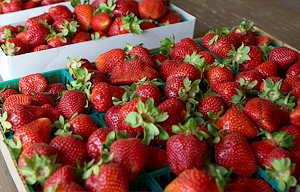
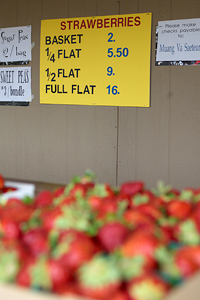
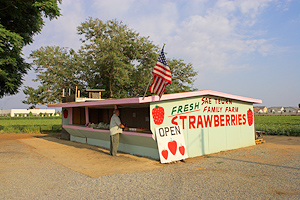
Fruit stands on this highway in the valley are many, and if you choose to go this route, make it worthwhile and DO YOURSELF A FAVOR and stop and get some of this fresh-picked fruit. And I do mean fresh-picked. Whatever is for sale has more than likely been picked that morning. This is what the San Joaquin Valley is known for. Take advantage of it. My Dad comes out here every so often from North Carolina, and every time I talk to him on the phone, he asks "What's in season?" Throughout the year, except for October through December, something is in season.
Between Oakdale and the hatchery, this stretch of road is actually very scenic, and is a very good road surface. You will come to a junction of highways 49 and 120 and you will see a trout hatchery. This will be a good place to stop and stretch the legs; the kids will LOVE the hatchery. They allow you to walk through the facility and they also sell trout feed you can throw in the water and watch the fish "boil" the water. Fishermen will salivate at the 5 to 10 pound trout they have in pens. BUT (and here comes the bad part...) once you pass the hatchery (intersection of Highway 49 and 120) you will hit a 6 mile section of the "Road From Hell" called Priest Grade. It turns into a very steep, 2-lane, narrow, sheer-face, hairpin-turn road that faces west, which, in the summer, will be easily the worst possible exposure to the sun's heat. There is NO shade anywhere on this stretch, and temperatures will easily reach 100 or more. If you are driving an RV, it is the worst possible road one could imagine. Unless you ascend this sherpa's trail in the lowest gear, and trudge up at 10 to 15 miles an hour, (thereby irritating traffic behind you and necessitating constant turn-outs) you will fry your engine. If you're in a car, your kids will be carsick, cranky, and everyone will have a headache. I cannot remember ever being on a worse road that was designated for summer tourism traffic. I would drive to any other route I could find to avoid this stretch of highway. The road surface itself is in great shape, but this is a true test of a vehicle's engine and transmission.
Once you get to the top of this stupid road, you will enter the town of Big Oak Flat. Big Oak Flat was an important way-station in the horse-and-buggy days of 100 years ago, and was the overnight stopping point for people traveling from the Bay area. There was a hotel, restaurant, livery and at the 4,000 foot elevation, a cool place to rest. Today, Big Oak Flat is an small town with very old buildings. There is nothing new here at all, and if you are in desperate need of water for your radiator when you get here, there will be a competent mechanic at the one-and-only gas station. There is nothing attractive about this burg at all, unless you are an aficionado of old architecture, most of which has been amazingly preserved. Beyond, you will enter Groveland, a far better place to be, but still lacking any appreciative accommodations. Groveland is an old, historic town, much like Placerville, or Mariposa.
There is very little here in the way of transient motels or hotels, but it's far nicer than Big Oak Flat. The road between Groveland and the park entrance is very good, with good shade. But I would avoid highway 120 altogether just to avoid the 6 mile section described above. Dissenting Opinions! (7/9/03) Regarding Highway 120 from a woman from Florida whom I assume is used to straight flat roads... "We were traveling from San Fran - Rt 120 was the most logical route. After reading your comments on 120, I was terrified to take it... however, we took it anyway (at night, in June, in a car), and the ride was fine. The pavement was in good condition, there was little traffic and the 6 mile stretch of twisty highway was not nearly as bad as described - no offense. We stayed in *charming* little Groveland in a bed & breakfast named Groveland Hotel. It was clean, extremely comfortable and convenient to everything we needed. - I'd highly recommend staying there to anyone. We're definitely going back... and we'll do just as we did this time. -Take 120 and stay in Groveland." Editor's note: Be sure and understand that my opinion of this road as described, in an RV or with a carload of kids, in mid-afternoon, in summertime 100+ temperatures still stands. At night with only two adults in a car, indeed the perspective does change. I maintain that under the conditions I describe above, I would choose any other route. -or- (2/13/04)"Your
editorial comments about Priest Grade..are exaggerative. I know people who
drive this road daily. If you are that spoiled - try highway 49 south from
Coulterville to Mariposa and then post your whining comments. Larry -
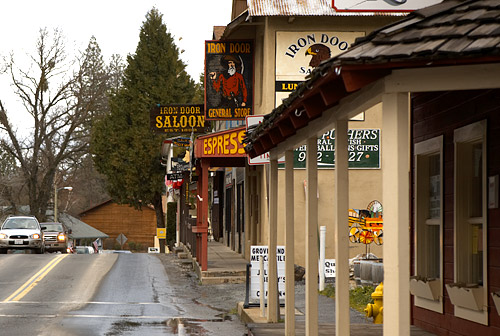
Greeley Hill Local -or- "We came in route 120 from the west. That last six mile stretch of road before Groveland is interesting, but it did not scare me enough not to use it coming out of the park. I found it acceptable." Hank from PA -or- (7/19/05) "I do want to make a comment about CA route 120 as I believe you're giving people the wrong impression. We traveled with another family and had 2 rentals with kids under 12 in each car. Traveling east after Lake Don Pedro, there is a fish hatchery on your right just before ascending Priest Grade. If you have kids, this is a fun spot to stretch your legs. We chatted with a man there and he recommended "Old Priest" rd which is a right turn after the fish hatchery. This little gem of a "short cut" is just a tad over 2 miles (6+ miles the other route) to the top of the grade, however it's straight up the hill and not recommended for RV's. We ascended this hill at 3:30 in the afternoon in late June and was ok. It really doesn't last long enough to overheat a car. We did have the windows down and shut off the AC. I 100% agree with you about Big Oak Flat; however, we found Groveland to be excellent. We stayed at the Groveland hotel and had dinner at an excellent little restaurant across the street. We then went to "The Iron Door Saloon" for a wonderful old-time drinking experience. I really felt I needed a cowboy hat and spurs. After talking with a few bar-maids, we were informed that there is a resort-like community called "Pine Mountain lake" in Groveland. Just like that we were back in civilization. We met another couple at the saloon who invited us to play golf at the resort the next morning. Great golf course. I highly recommend a stop in Groveland, CA for the joy of an old-western style experience and a wonderful round of golf." Editor's note: Everything these folks say is true. I'm not throwing rocks at the Groveland area, just letting you know it's not the land of McDonalds and 7-11. If you take the 2-mile super-steep short cut, then obviously my comments are not valid. But if you go the 6 mile route, I still maintain it's brutal. THE BEST ROUTE INTO
THE PARK IS ON HIGHWAY 41 FROM THE SOUTH THROUGH FRESNO!!
Arrange your itinerary so that you spend the night before entering the park in either Oakhurst or Fish Camp. Stock up on all your gas, film, food, toys, and other necessities in Oakhurst or Fresno, and head to your hotel. (Be forewarned: Photo film costs 50% more in the park than in Oakhurst or Fresno! Plus, they only carry Kodak film; NO Fuji film at all except at (you guessed it) the Ansel Adams Gallery! Digital storage cards for your camera are for sale at the Ansel Adams Gallery, but they only have 1gig sizes, and although not expensive, you can find them much cheaper elsewhere.) Even if you arrive in Oakhurst or Fish Camp in early evening, resist the temptation to just keep on going. By no means should you arrive at the park during the night. You can't see anything!! You will be depriving yourself of half the reason you came here in the first place! Go to the Visitor Information Center in Oakhurst, beside the Mexican Restaurant north of Oakhurst and get your maps and study them the night before. Read some of the rules about what to do and NOT do so you can focus on seeing stuff the next day. Above all is: do not feed the animals!! I repeat: DO...NOT...FEED...THE...ANIMALS.... It's a $250 fine! The Coyotes will trot up and down the road waiting for food to be thrown out the windows of passing cars. People just cannot resist the temptation to feed them. DON'T DO IT!! Don't feed deer, and for God's sake, take SERIOUSLY what they tell you about bears; and read my bear section.
Have Your Camera
At-The-Ready At All Times! One of the first things you will notice as you drive along Highway 41 (always with the windows down!) is the wonderful aroma of Bearclover, which is a very fragrant bush common in the foothills. It has a sweet smell, resembling cedar, and some people don't like it, but I think it smells wonderful. This aroma is not to be found on any other route into the park. Take your time on this road! Early morning in the forest during summer is beautiful! 7:45am or so 8:30am 9:00am 10:00am
12:30pm Don't
forget, you MUST take a picture of your group or family or each family
member individually, with the valley in the background. 1:30pm Next part of the trip you will be making your way through the valley floor. GO SLOW! I'm talking 10 to 15 miles an hour or less. You WILL miss something if you zoom down this road. It's a two-lane, one-way road, so if anyone wants to go around you, they will have plenty of opportunity. This road was built specifically for rubber-necking, so don't feel guilty about inching along. Get out at the Swinging Bridge and walk across it. There are nice views of Half Dome, Yosemite Falls and El Capitan from here. Kids can play in the water, or chase squirrels, or just hang out with the other kids that will be there. There is a rest-room here. (It will be here that the mosquitoes start to get bad starting in late June through late Sept.) As you proceed down the road, you will see Yosemite Falls, Half Dome, the Chapel, and so many unbelievable vistas, one after another. Stop and get out and take pictures! These will be the touristy areas, so just expect the crowds and traffic. It's still awesome to see this stuff and take the pictures. These vistas will make the worst photographer a pro. You can stroll on the boardwalks built for that purpose; just don't walk in the meadow. If you take your time and don't rush, it will take you about an hour to drive from Bridalveil to Yosemite Village (grocery/gift shop, etc.) 3:00pm Do whatever your heart desires. At some point, you should include a visit to The Ahwahnee Hotel which is very near Yosemite Village. DO NOT FAIL TO SEE THIS WORLD FAMOUS LANDMARK!! 6:00pm For those who want a VERY special dinner I cannot recommend the Mountain Room at the Yosemite Lodge enough. I have eaten at this restaurant about 20 times, and always had a spectacular meal with the world's best service and gorgeous, formal surroundings. I have never had a bad meal here... The Ahwahnee is that place-to-go-once-so-I-can-say-I-did-it. Spectacular is the only adjective that works. The food AND the prices AND the dining room itself. Count on $80 to $100 per person depending on how much of and how good the wine. They have a great Sunday brunch; $55 per person and NO waffle bar! :-( Curry Village would be a choice for several reasons. It's all-you-can-eat buffet ($15 for adults, $12 for children, $13 for seniors) with a wide variety of choices, very casual, large groups no problem. The food in the past has been very bland, but recently they hired a new chef and the food has improved considerably. At Curry Village, make friends; there's a gazillion kids zooming around and a real family atmosphere here. Your teenager will absolutely love the Curry Village area. It's home to the pizza and taco places, the mini-mart (sodas and chips), and many, many other teenagers. Trust me, they will find each other and make fast friends. The pizza place in Curry Village is surprisingly very good! And not a rip-off like so many other things are in Yosemite.
The park guidebooklet that the ranger gave you at the main gate will tell you where all the places to eat are; these are just my favorite. 7:30pm
8:00pm or... Yosemite night life is spectacular! If there's no moon, you will swear you are in a planetarium. Brilliant stars... During the middle of August, the Persied Meteor Shower will be unbelievable... Plus, you can spread out a blanket in El Cap Meadow and watch the stars and/or the climbers lights as they sleep on the mountain face. Incredible. Hike to the top of Sentinel Dome and watch a 360 degree totally unobstructed view of the sky from an altitude of 8,800 ft. Nothing but the breeze can be heard. Go to Glacier Point and see the valley below in lights and the heaven above in stars. Total quiet. Tuolumne Meadows at night? Need I say more... from here you can see satellites, space craft... all from the naked eye.
7:00am As you leave the valley floor and head up hill on Highway 120 East (or the Tioga Road), you will pass through three small tunnels. There's nowhere to stop aside from small turnouts. Your first stop will be at the Crane Flat gas station on the Tuolumne Meadows turnoff, Highway 120. A pit stop here is a good idea to stretch the legs and visit the facility. I say that, because there is very little in the way of "facilities" between here and Tuolumne Meadows. As you proceed eastbound on Highway 120, you will ascend higher and higher to about the 8,500 ft. elevation. Ears will be popping. You might want to stop at White Wolf Lodge for a while. They are not real big on transient traffic, but the grounds are nice and you can rest a bit. Keep going to your next stop, which is Olmstead Point. This is a photo vista with no facilities at all, but the view is very nice. You can see Half Dome from here, and obviously, it's from the opposite side that you see when you're in the valley. But, from this vantage point, you can see what the hikers have to ascend when they climb to the top. Quite Imposing!!
Next, about 10 minutes later is Tenaya Lake. There are picnic tables and shady places to hang out. Fishing is pretty good here, too! No motor boats, though. Between Tenaya Lake and Tuolumne Meadows, you will pass some good climbing areas, and inevitably there will be people on the face. Traffic in this area gets STUPID as people rubber-neck looking at the climbers, and taking in the views. |
|||||||||||||||||||||||||||||||||||||||||||||||||||||





|
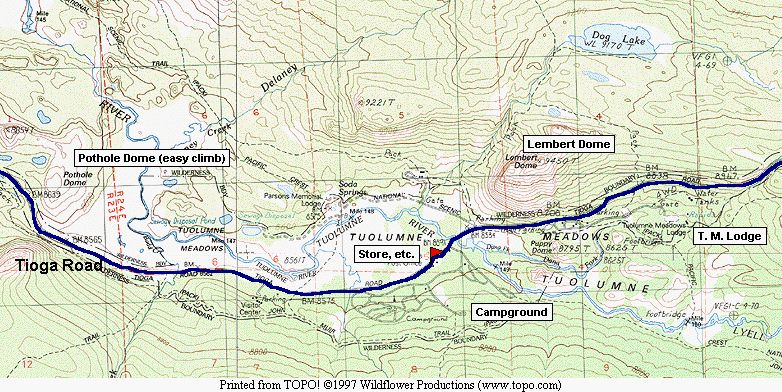
Most of your day will be spent in doing some light hiking, (or heavy hiking if you prefer) taking pictures, or climbing Lembert Dome. If Lembert is too much for you, try Pothole Dome located on the western area of the meadow. Both of these are huge granite domes that rise up from the meadow. They are easy to climb, but Lembert is about 300% larger than Pothole. Also, try Pothole Dome at night for spectacular star-gazing. At some point, you should go up to Dana Meadows, which is east from Tuolumne Meadows, just inside the east park gate. There is spectacular scenery here. Plus, I would strongly encourage a short trip to Saddlebag Lake, just outside the park boundary. This is an unbelievable area, with spellbinding scenery and a very nice lake with lots of big fish. Rent a boat and try your luck! The kids will love it! Fishing is also very good at Tioga Lake, which is just outside the park gate. That's It! Two days and you've
seen 90% of what there is to do in Yosemite! Of course, you will not have seen
much of the back country, or done much hiking out of the valley floor, but your two days
will have given you a taste of everything the park has to offer. Plan another longer
trip to spend more time in places that caught your attention, or, if you planned a longer
stay the first time around, you can now indulge in those things on your third or fourth
day. |